Sometimes Sharks Travel in Packs: on Group Teaching

by Audrey DeVault

Building a 6-week course from the ground up is a significant undertaking. It’s not something that fits in easily with an already busy schedule, and as such, when my co-teachers and I first considered teaching a course through HSSP, we were hesitant. 

We are all rising sophomores at Caltech, and many of us have full-time research positions for the summer. After factoring in summer courses, other part-time jobs, and socially distanced visits with friends for sanity, we each only had a few spare hours per week. 

This is where group teaching came in to save our schedules and make our class something truly special. 

If we were to have taught our class, Cool Theories in Math & Physics by Caltech Students, with less teachers, it would have certainly been harder on us. Group teaching has allowed us teachers to do all sorts of other things during the summer. For those curious: 

Max is researching an interferometric technique for exoplanet astronomy that blocks the light from the star and enables the direct imaging of exoplanets at closer proximity to their stars than ever before by conducting computer simulations.

Gabby is determining how sensitive the Cathode Strip Chamber (CSC) (the endcap muon system in the Compact Muon Solenoid at the LHC) is in detecting long lived particles that decay in the CSC.

I am working with NASA’s NuSTAR space telescope to search for pulsations in the hard x-ray range of pulsar observations utilizing new clock corrections that yield unprecedented levels of precision. .

Dividing the work has allowed us to work on our research and HSSP concurrently, without sacrificing the quality of either. 

While a lighter workload is a fairly obvious benefit of group teaching, something much more important has become clear in hindsight: Teaching in a group didn’t just make things easier, it made things better. 

Our teaching group is the second largest at HSSP this year, with 5 teachers. While we know that it is more common to teach in pairs, our experience with group teaching has been amazing, and we urge others to give it a try. Beyond lightening the individual load, it allowed us to make our class much more diverse, complex, and polished than any subset of us could have accomplished. 

Every Friday night, the 5 of us meet up for a practice lecture where the 1 or 2 people teaching the next day’s class perform a full dry-run of the material. We found this to be an extremely effective way for the presenters to hone the material and teaching style, and for the remaining teachers to gain a better understanding of the subject so that they could aid in answering questions during the real lecture. 

I asked each of my co-teachers about their experience with teaching in a larger group and they each responded with their own unique perspective: 

“The best part about teaching in a large group is that it is easy to get many perspectives on the lecture material and approach to the material from the other teachers. I found that this helped our group immensely with choosing what topics to focus on, and how we could build upon the material we were teaching while still covering our wide variety of subjects.”

Maximilian Adang

“We were able to teach a much larger assortment of topics given our wide array of unique and particular passions within math and science. Since we were able to divide up the various lectures, it gave us ample time to strengthen and review our lectures, adding more detail to the topics and transforming our teaching to be more interactive and fun for the students. As a team, we were able to combine our interests to teach new topics previously unreachable.”

-Ely Jrade

“Teaching in a large group has made our course the best possible version of itself- with so many talented and smart collaborators, we were able to present the most interesting subject matter in the clearest way.”

-Gabby Dituri

“It has been an incredible opportunity to be able to teach a summer class with my fellow co-teachers. Being able to work closely with my friends made the course not only enjoyable to teach but also an important experience in collaboration. Working with a relatively large group of co-teachers also made sure that our content for each lecture was well reviewed and relevant.”

-Eitan Rapaport

Teaching in a group, especially with friends, has made our time with HSSP extremely fulfilling. We have learned so much from each other and have produced a class we are all fiercely proud of. I encourage any future ESP teacher to give group teaching a try, even if they aren’t suffering from an overcrowded schedule. Once you find a good group of people to work with, collaboration yields nothing but benefits. 

P.S. Given that this year’s HSSP mascot is a shark, I think it’s worth noting that many types of sharks work together in large groups to hunt and socialize- If great whites can do it, so can you!

A Blog on Teaching

by Bil Lewis

Dear Blog…

My “philosophy” of teaching is based on the idea that I can drive the students crazier than they can drive me.

Ha hahaha…

But in a serious way, I want the students to be interested, excited in what we’re studying, and laughing.

I dress and teach as James Madison (4th President of the United States), which transports us out of 2020. We are concerned about the Yellow Fever taking the lives of 1/10 of Philadelphia in the fall of 1793. It adds perspective.

I tell them about my friendship with, then opposition to, Hamilton and his schemes. It’s personal. We’re people now, not symbols.

I ask them to join me and we read poetry, sing songs, and perform skits. They get to be Hamilton and Washington and Dolley Madison and Paul Jennings, reading the words that those people wrote, and reenacting what they did.

This works extremely well in person. I am loud, I am excited, I am practically a cheerleader. We are clapping, we are yelling, we are shaking our fists at the British.

And it works. They get excited and it becomes an adventure.

Teaching for Spark! was like teaching at Hogwarts, except every student was Hermione Granger. A sea of waving hands, “I want to do Hamilton! No! I want to! Me! Me!”

Over Zoom… it’s more difficult. It’s too easy to leave one’s camera off and just be a silent observer. My attempts at drawing the quiet ones in has not been very successful. I’m struggling with that.

PART of ESP is learning stuff, but the other big part of it is meeting peers, making friends. How can we promote that?

It is such a joy. When the students get into it, we have a blast.

It’s a crazy amount of work. But it is so rewarding.

Thank you, all you organizers who make this happen!

-Bil

Scattered Thoughts

by Mandar Juvekar

Since the start of HSSP many scattered thoughts vaguely related to the program have called my brain home. Some serious, some not as much, these thoughts have helped keep me entertained through an otherwise monotonous summer. Here is a quick highlight reel, with the hope that perhaps one or two of them might entertain you as well!

On teaching over Zoom

A fairly normal subject that I’m sure many people involved in the program must have thought of at some point: I have been thinking a lot about the experience of teaching (and learning) via Zoom. In my opinion, one key thing that Zoom misses that makes a real classroom more exciting is the ability to have small-group conversations during a class, both for learning-related and non-learning-related purposes. Zoom completely takes away the possibility of teachers asking students to “chat with your neighbors”, or for students to clarify small things with those sitting next to them, which I think plays a much bigger role in learning in a classroom than most people would think. I also think that while potentially distracting, the ability to carry out mini side-conversations (even just a few words here and there) among students during a class is important in helping students stay engaged. Being physically located near other students is another thing Zoom misses out on. In my opinion, physical proximity brings two things to a classroom. First, it forces students into each others’ fields of view, which causes an implicit “peer pressure” (for a want of better words) to participate. And second, as a teacher it is so much easier to figure out how students are responding when it is possible to (easily) see the students while teaching. A virtual environment which somehow incorporates these things in a sensible manner would be quite interesting to see: some sort of hybrid between Online Town and Zoom, perhaps?

HSSP as a Splash admin at a different school

I am currently the chair of the Splash at my own school, the University of Rochester, and one of the best things about teaching at HSSP is not having to deal with (or even know of) all the craziness that goes into organizing the program. This is particularly the case right now, just a few weeks after one of our own summer programs ended: after four long, busy weeks of answering emails from students and teachers, rushing around on the days of the event, and dealing with technical difficulties, I now have the chance to be on the other side and just focus on teaching something I love. I think this was a much needed break for me. Being an admin at a much newer (and smaller) Splash, teaching at HSSP has also been a great way to learn from a larger program and get ideas that could potentially be incorporated in our own programs. Having experienced what goes into organizing such an event, I really appreciate all the hard work the HSSP team puts in to keep the program going. You all are truly incredible. Kudos!

On self-similar structures on a plane

A very short and unrelated thought: Highly Self-similar Sharks on a Plane always reminds me of a math research project I’m working on right now which studies extensions of Paul Erdős’s “Distinct Distances Problem” in combinatorics. The problem is that of finding an (asymptotic) lower bound on the number of distinct distances any n points in d-dimensional space can determine. The problem was almost entirely resolved in two dimensions (the plane) by Larry Guth and Nets Katz in 2010 using what came to be known as the Elekes-Sharir-Guth-Katz framework. While I’m not going to go into details (this isn’t a math blog, after all), it turns out that one of the key ideas in this proof was to study quadruples of points such that two of the points can be transformed into the other two via a proper rigid motion: highly self-similar structures in the plane! Yes, I know this connection is a bit of a stretch, but I thought I would put it in here anyway. If you are interested, I really encourage checking out the distinct distances problem, the many fun proofs for different lower bounds that came up over the years, the ESGK framework, and the Guth-Katz result in the plane 🙂

On naming HSSP

Just the other day, I was talking to a friend of mine who is an ESP admin about the naming of HSSP. He explained to me how the trickling of HSSPs into the academic semesters caused the full form to change from High School Summer Program to High School Studies Program, and how that name ran into issues once middle schoolers were allowed into the program. The conclusion of this conversation was that now HSSP is simply named pretty much anything that (a) sounds good, and (b) makes for good artwork. This got me thinking. If the full form of HSSP drives artwork, couldn’t a particularly evil director name the program with the sole purpose of making artwork design as difficult as possible? One way to do this would be to have a name so boring that designing interesting artwork would require a particularly brilliant creative spark. Perhaps something like Hand-drawn Squares on a Sheet of Paper, or Highly Self-Similar Spheres on a Plane. Another way could be to have a name that represents something literally impossible to visualize directly. Perhaps something abstract, or maybe something in 4+ dimensions? Maybe High-dimensional Structures Shine with Purity or Honesty Shows Sincerity and Prudence? Of course, it is very possible to turn these names into beautiful artwork, I just think that might take a lot more effort and creativity. Now don’t get me wrong, I bear no malice to the ESP art team. Quite the opposite, in fact: I really appreciate their work, and am a big fan of this summer’s shark-based art!

Lesson Learned

by Zara Nip

Welcome to “Online Schooling v.1.0”. Press “enter” to begin.

—> enter.
—> 21 March 2020.  The teacher announces that turning off the camera and microphone functions during class was treason.
—> You forgot to capitalize your last name. Strike 1. Press “next” to proceed.

—> next.
—> 4 April 2020.  Charlie Baker extends online learning. The result is a 5 page document with rules regarding cameras (always on and frontward facing), microphones, appropriate school-regulated backgrounds (natural or none… unless you’re a teacher then you can have cows and grass as your background), PG rated clothing (🤔), and three pages of etiquette in regards to participating in class, being kind to others, blah blah, blahhhhh. 
—> You changed your background to a picture of an Oreo. Strike 2. Press “next” to proceed.

—> next.
—> 15 June 2020? 28 May? Time is a social construct! Those fortunate enough to have split screen monitoring had the great privilege of surviving the third class of the day—another documentary about WWII or was it mitosis?—without resting their eyelids, as we fondly call it. 
—> You got caught sleeping during “Phases of Mitosis” at timestamp 10:37. Strike 3, and… you’re out. Press “next” to proceed.

—> next.
Beeeedooop *insert Microsoft powering down sound effect here*.
Loading last saved memory.
Error 56! No memory found since 17 March 2020.
Congratulations! You have failed one (1) year of online learning.
Press “next” to proceed to the 2020-2021 school year.
Press “go back” to rewind back to 1 January 2020.

—> go back.
—> Error 203! NoSuchFieldException.

—> next.
—> Error 165! RunTimeException.


WORTH IT: Class Size

by Dominique D.

Inspired by the popular Buzzfeed show, Worth It, I am going to compare three different class types at three drastically different price points to see which one is most worth it for its price. But the catch? We’re not using price. And we’re not eating any food. Unfortunately. Instead, I am going to be comparing class size from the tiny 10 person classes to the largest 200+ lectures.1

$$$ < 30 People

The first “price” we’re going to discuss is the smallest class. These classes are normally activity or discussion types with a strong focus on hands-on projects and participation. It’s the type of the class that if you don’t meet someone new after 6 weeks of learning, you’re doing something wrong.

Advantages:

  • Burning questions will be addressed immediately
  • Close-knit environment

Disadvantages

  • You have to talk, build, write, and sit next to people (which could be an advantage for some people!)
  • Those burning questions will take up a larger part of the class time

In my opinion, the best feature of this class size is the intimateness it achieves. You and only a few other students are completely immersed into a topic that the teacher is clearly passionate about. 

$$$: 30 < People < 100

The next price point is the medium class size, from 30 to 100 students. Classes range from discussions to seminars that include some projects but do not require as much participation. Most of the classes are in this range so if you’re looking for diversity in your schedule, you’re in the right place.

Advantages:

  • More material and presentations, less questions immediately
  • Content is geared toward individual likes and dislikes

Disadvantages

  • Individual ideas are not expressed as much
  • Hard to ask questions as it stops the flows of the class

Final thoughts: it’s not terrible but it’s not the best. There are definitely good parts and not so good parts but it’s a welcomed break from an extremely small class to a large one.

$$$: 100 < People

The final price point is the largest class size and the most intimidating. Classes include seminars and lectures usually in a large hall or auditorium. If you want to change a class on the day of, you want to change to a larger class because you can drop in and immediately follow along

Advantages:

  • Questions don’t exist – pacing is fast and material is direct
  • You don’t have to sit next to anyone if you don’t want to

Disadvantages

  • Questions don’t exist
  • Content focuses on the breadth not depth
  • Impersonal (the teacher won’t remember you and you won’t remember anyone)

This class size is a hit or miss for me. Some classes were hilarious, informative, and I walked away with random knowledge (i.e all of the Wikipedia classes) but others were dry and confusing, leaving me with less knowledge than before. 

The Winner

After reviewing all class sizes (and heavily racking my brain on the classes I took), my Worth It Winner is < 20 People. Even as a person who does not like meeting new people, the relationships gained from listening and talking to my teachers and peers outweigh the disadvantages. The bond created between the teacher and student is unparalleled to another other class size and I have always left with a new piece of knowledge. Of course, content affects the experience but, I would take a < 20 people class size over a 100+ class size any day. Although I’ve been attending zoom meetings, I’ll be back in MIT at an ESP event soon enough and you will most likely find me in a < 20 people class. 

How we’re teaching high schoolers to code, online

by Cameron Kleiman

When Christian and I decided we wanted to teach high schoolers about the novel programming language Julia, I knew we would need a certain amount of infrastructure in order to support our students. One particular interest of mine was making sure our solutions scaled. We opened the class to 50 students, with a target of 30. I wanted to make sure if we had 10, 30, or 50 students we could support them. So, a course website was in order.

Additionally, we recognized that not every student is going to have access to a programming environment, nor will they have the technical knowledge to set up one themselves. And that’s okay! Often, setting up a development environment can be more challenging than (and irrelevant to) the programming itself. We wanted to support these students by providing them with an opportunity to develop in the cloud, especially for students using devices like Chromebooks and iPads.

The technical details

Choosing a domain name

For the class domain, we wanted something short and fun that students could remember easily. After looking through a lot of options, we settled on julia.party because it captured a lot of the sentiment Christian and I shared about the class. Christian and I often express how much fun it is to code in Julia, and we wanted our students to share our appreciation for the language. At the end of the day, we were going to try to make class feel a bit like a party.

About the course website

For the course website, there was one obvious choice: Franklin.jl. I knew we would need a static-site generator, like Jekyll, Hugo, or Eleventy, but picking Franklin was just a matter of practicing what we preach. While Franklin’s not as featured as those other site generators, it does the job, and its built-in “basic” template was perfect for a stripped-down, professional course website. Additionally, consistent with Julia being a scientific programming language, Franklin has some nice built-in features, like LaTeX support.

To deploy the website, I chose GitHub Pages, as Franklin actually comes with a GitHub Actions workflow to automatically deploy to GitHub Pages whenever you commit new changes. This became incredibly handy because I could edit the live course website with a simple push from my laptop or by editing the files directly on GitHub.com. You can see the course website and automatic deployments in the GitHub repository.

Jupyter notebooks and the code server

To actually teach the class, we decided on Jupyter notebooks, using Julia’s notebook package IJulia. Jupyter notebooks offer a unique combination of instruction and interactivity, so we could use them as both a teaching tool and a way for students to write their own code.

For the online development environment, The Littlest JupyterHub (TLJH) was a natural choice. JupyterHub is a platform that allows for automatic provisioning of Jupyter or JupyterLab environments over the internet. TLJH allowed us to run a single server for all the students needing to develop in the cloud, with minimal setup. (It also provided the platform on which I wrote this blog post 😊) I chose Amazon Web Services Elastic Compute Cloud to host the server, as I could quickly provision a server with the resources needed for our 35-50 students to have a place to develop on a moment’s notice, with the ability to resize if necessary. (Spoiler: it was necessary.)

Getting students set up for class

To get our students set up for class, we used the concept of a “Welcome form.” The class Welcome form contained survey questions to get a sense of our students’ programming experience and the resources needed for the code server, as well as a step by step guide for getting students set up with Julia and the other various tools used in the class. This allowed us to start programming on day 1 because all of the students were set up on the tools we had given them.

Establishing motivation for learning Julia

In order to teach a programming language, students need something to code. For this, we relied on Project Euler, a library of mathematics and programming problems. Christian and I are big fans of Euler already, having solved over 100 problems ourselves (regrettably, mostly without using Julia). The problems give our students a way to gain experience with Julia without us having to invent a large number of programming exercises.

What this allows us to do

Together, this allows us to create an interactive learning experience for our students. For each class, we distribute a Jupyter notebook containing some light instruction and empty code blocks for students to fill in on their own as we teach.

At the end of each class, we typically assign a few Euler problems for students to optionally try to tackle to gain more experience with Julia, and we offer students the ability to present their solutions at the beginning of next class. If they get it right, fantastic! The presenter just learned more about their own solution by having to explain it, and the students get to pick apart a solution to a problem. If they get it wrong, even better because everyone has the opportunity to debug as a class with our help.

The goal of teaching the class this way is to encourage students to be curious about the solutions to mathematical and programming problems, in an effort to have them play with the language on their own. We can give them the tools they need to be successful, and along the way, we’re there to support them however they need.

The bumps along the way

One modification to the infrastructure we had to make to the code server was to scale it for additional usage, after running out of memory and crashing it during class. The issue has to do with the number of students programming at one time on the JupyterHub server. However, because we’re using AWS, this is super easy. I can just take the instance down, change the instance type to have more memory and CPU before class, and bring it up within about 5 minutes. This costs more money, so I downscale it after class so students can code during the week.

Make no mistake, the server is expensive ($100 a month or so), but scaling it during class lets us avoid making it cost twice as much.

Putting it all together

The Jupyter notebooks, class website, and code server all serve important roles in how we’re teaching our students to code, online. With all these pieces of infrastructure, we think we can provide students a relaxed way to learn a new programming language, giving them the opportunity to learn how they want to learn. We try to keep class time chill and flexible to adjust to what students are most interested in or struggling to understand, and overall, we want to provide a safe space for students to be curious and talk about technical concepts.

It’s been a lot of fun, and through the process, Christian and I are learning just as much as our students. Teaching for ESP has been something special and has given me an opportunity to switch roles from a CS student to a CS teacher. I certainly have a new appreciation for MIT’s amazing CS professors and what they do.

Dipping My Toes into Online Learning

by Arianna Krinos

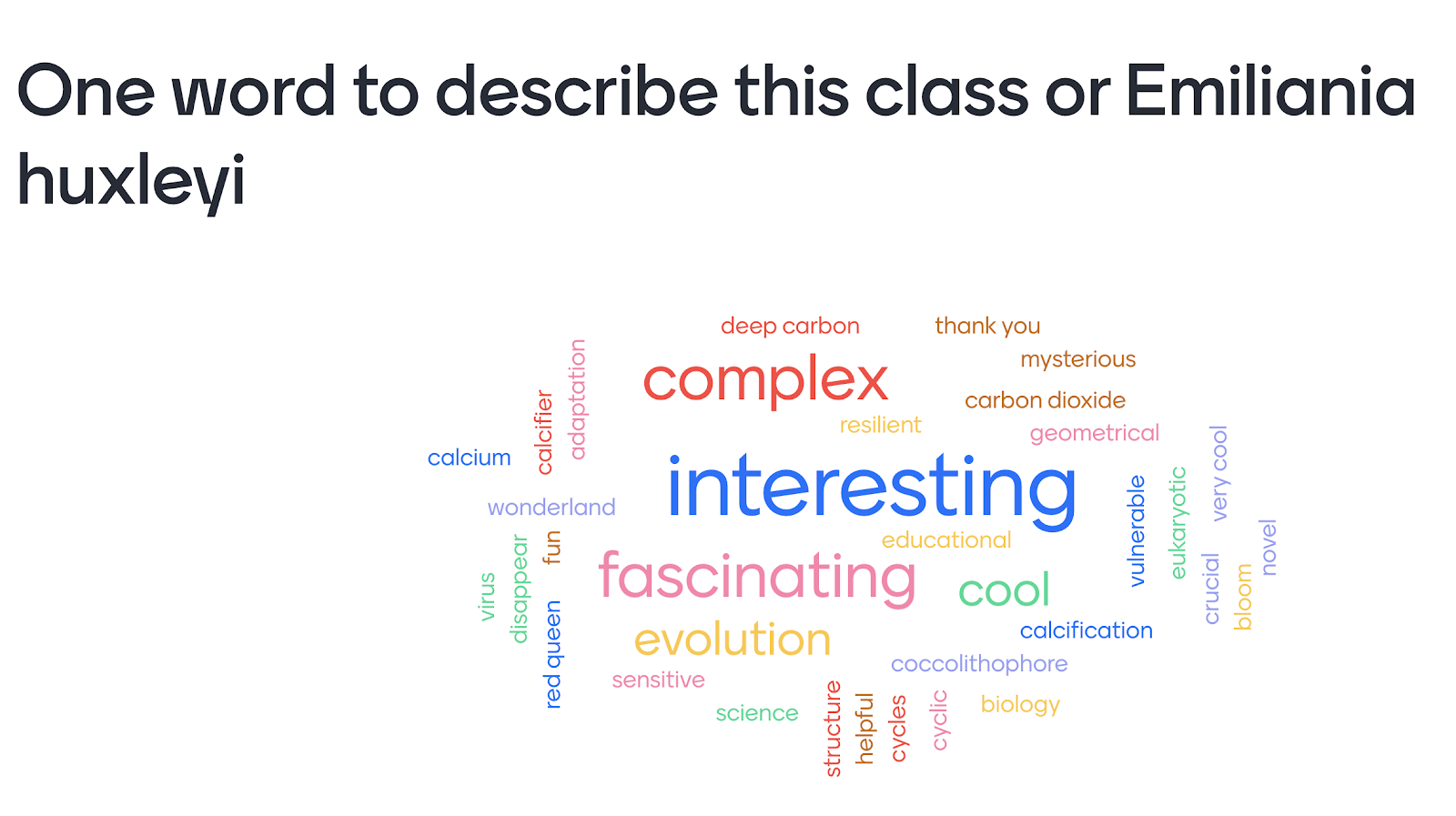
        In step with the random extra Shark Week TV specials we’ve been blessed with as an unintended positive side effect of the quarantine, this year’s shark-flavored HSSP was an atypical venture into extracurricular education for high school students. With serendipity, my area of study also happens to be Biological Oceanography, and my first real foray into online teaching with a full, real class was during Rainstorm early in the summer, wherein I taught a short course on coccolithophores, calcifying phytoplankton that leave a major mark on the global carbon cycle.

        From that point, the forays only multiplied, from one-on-one tutoring sessions, to Software Carpentries workshops, to e-meetings with advisees, and now HSSP. My HSSP experience as such has benefitted tremendously from early lessons. For example, a disastrous attempt at breakout rooms, to the chagrin of many students who preferred cameras and videos to be off, helped me refocus my interactive content to online polls and directed questions.

        Now, on the heels of the third week of HSSP, I feel much more equipped to be an online teacher, and excited about the future of education, particularly given the seamless grasp that young students seem to have on technology. Often, the students are better equipped to troubleshoot Zoom or share content than I am, and I find that to be a tremendous opportunity to advance and increase access to learning in the future. In particular, HSSP has been expanded to students across the country, without them having to step out of their homes. Further, many of the younger students I work with are interested in learning coding skills, and grasp those initial concepts (which were once totally foreign and difficult to me) with ease and grace.

        Specifically, I am co-teaching a class on Bayesian analysis for HSSP. The zeal that the students have for learning is absolutely phenomenal, and I am honored to be able to teach them. So many of them seem genuinely excited to come to class, and ask truly insightful questions. The online format seems to be no problem for these energetic students, who seem only excited about the ability to attend so many different courses at once.

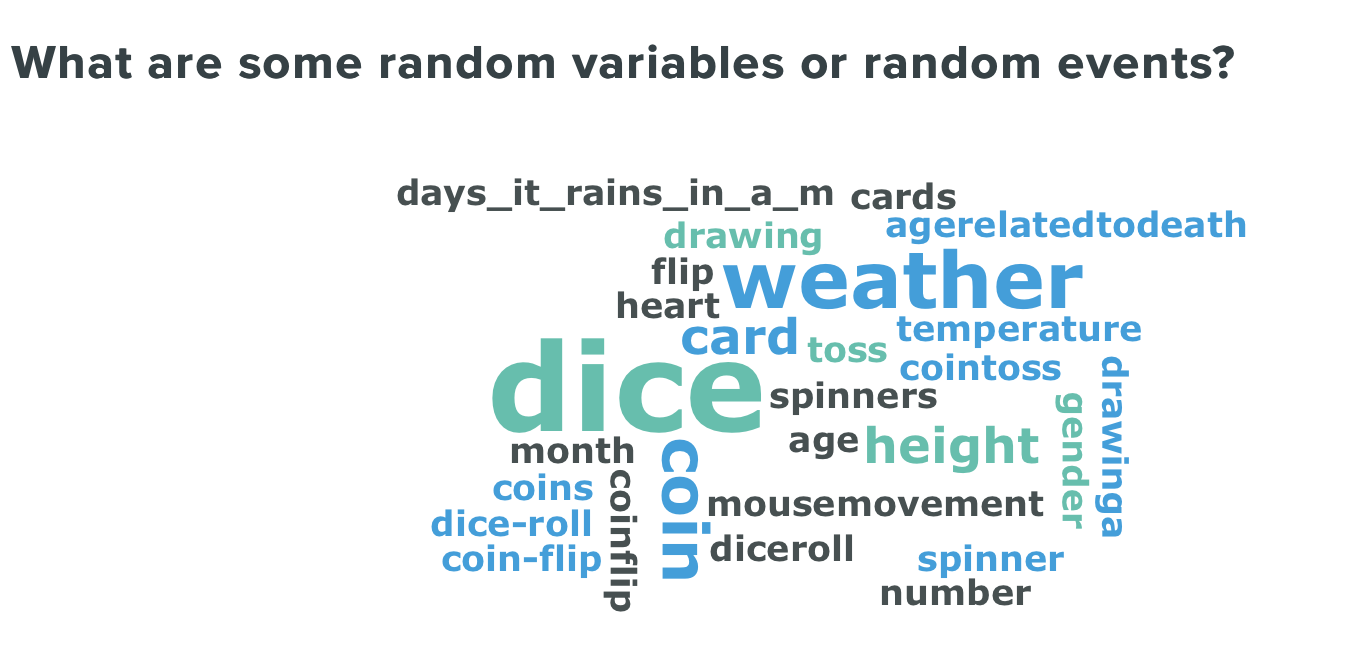
        Embracing randomness and Bayesian inference with them has been a blast, especially to relate it to concepts that are really exciting to me from biology…and even to COVID-19. I am so excited to continue to explore more in the realm of posterior distributions, genetics, and the Bayesian basis of antibody tests with them in the latter half of our short list of sessions!

Predatory Zooms

By Eda Erdogmus

What does distance learning (or, virtual learning–depends who you ask) and sharks have in common? Is it a one-way respiratory system, also known as gills? Is it the limited accessibility (i.e. sharks are limited to their respective layer of the marine ecosystem, and distance learning is limited to when in-person is too risky)? 

  The etymology for the word “shark” reveals that the word most likely means “predator, one who preys on others.” In Dutch, “schurk” means “villain, scoundrel.” Sound familiar? Perhaps these adjectives are reminiscent of the experience many of us have had through distance learning. 

    Distance learning comprises its own challenges which both students and teachers have had to deal with over this past semester. Internet connectivity problems, failure to understand and comply with Zoom etiquette, embarrassing instances where one’s camera or microphone were not turned off or muted, respectively, all make up only a fraction of negative experiences with distance learning. Combined with the tedious (seemingly busy-work) teachers have resorted to providing, it paints distance learning in an aggravating light; a sour taste left in the back of one’s mouth. 

    The transition to distance learning has left thousands of students in distress; I, myself, and many of my friends certainly suffered from having our strict schedules being ripped away so suddenly. In a matter of hours, we had lost our club events, parties, SAT testing slots, and the very structure which held up our lives: school. 

    How does this relate to the shark? A beast, which in reality, is a gentle occupant of the sea, a creature which evolution has deemed so pristine and perfect, there has not been major changes in the organism since the Permian–that is, millions, upon millions, of years. If we view the shark through a critical lens, then one will see that, in theory, it is a bulky and primitive design. A shark shall perish if it does not continuously move, for it has no way to pass water through their gills otherwise. A shark can not recognize the difference between a seal and a human on a surfboard. What benefits would come from a shark needing to go through some 30,000 teeth in their lifetime? Why do they not have teeth affixed to their jaws? 

    We see the shark as a dangerous predator, constantly out for blood–our blood. We make media portraying this, and have characterized the creature as some sort of monster. But a shark does not know any better than the prey it is hunting. Sharks should not be feared, they should be treated with respect. 

    Distance learning is similar to the shark. Something we have learned to be reviled, that is heinous, and detrimental to our wellbeing. With all honesty, it is true. Students without access to stable internet, a computer, or the time to attend their classes because they suddenly had new responsibilities thrust upon them, are suffering. Students who need the support of their teachers are suffering. Students who need the support of their friends are suffering. But like the shark, perhaps the issue is not the predator, but the emotions which are formed around it. 

    There are many schools who are online only, and students who attend get a proper education. Most of our experiences with distance learning coincided with the onset of major life stress. This is not all too different from how many of people’s encounters with sharks are through an attack, or witnessing one. 

    Perhaps we need to address that distance learning is not the issue. Our instructors tried their hardest to provide us with enrichment opportunities through less-than-ideal conditions. We were trying to beat odds that were stacked against us. 

Our lives share more with the humble shark than we may think. Its structure is identical to the cartilaginous skeleton of the shark; while it is sturdy and flexible, serving our daily purposes, it is reduced to nothing with the flowing sand of time. Distance learning should not be denounced, for it is doing nothing wrong; just like the shark. 

Evil Dolphins? I Think Not!

by Gauri Kumar

Here’s a clip of a whale shark opening its mouth incredibly wide

Sharks. Yeah, those animals that look like evil dolphins. I’m just speculating here, but they could just be mutated dolphins, right? Like how narwhals are mutated unicorns. Unfortunately, sharks are part of a different family and are not closely related to their less evil look-alike, the dolphin. So if sharks aren’t just weird dolphins, what even are they? Where did they even come from? I honestly thought that sharks popped into existence exactly as they are now. In truth, time has really changed sharks and gotten them to do some pretty incredible evolution. 

What even are they?

The shark is an amazing animal. Its whole body is built for speedy swimming. Its head shape, the shape of its fins, and even the scales on its skin are all made to improve its aerodynamics. Its weight also helps. With no lungs and its skeleton made of cartilage (the structural stuff in our nose and ears), the shark is relatively light. 

To be honest, sharks are kind of crazy. There are more than four hundred different types of sharks. Some female sharks in captivity actually reproduced by themselves — that’s basically cloning! Speaking of female sharks, they typically birth live baby sharks called pups (awww). The babies may sound cute, but are competitive to the point of murder. The strongest pup of the sand tiger shark eats its weaker siblings in the womb. 

Sharks may cut through water with great grace, but they’re messy eaters. They lose teeth when they eat their prey and some sharks lose more than 30,000 teeth. Luckily, sharks can easily grow their teeth back, and with no set number of teeth like humans, the possibilities of how messy to be are limitless. Typically they shed their teeth one by one, but not the cookiecutter shark. Its lifestyle is far from cookie-cutter as it sheds a whole row of teeth all at once.

Lastly, sharks are also famous fish. Yes, sharks are fish and not mammals or whatever random animal category you imagined. No more cute little clownfish, now you get savage sharks. Those savage sharks actually hold some pretty fancy titles. The oldest living vertebrate in the world is a Greenland shark that’s at least 272 years old. It totally wrecked the old record of the bowhead whale at 211. The biggest fish of today is the whale shark — not a whale, it’s a shark. It’s 44 feet long and weighs 15 tons. Adult male African elephants only weigh up to 7 tons. The biggest predatory fish is probably one you already know: the great white shark. If you’ve ever seen a picture of one you’ve probably noticed its mouth twisted in a freakish smile. Those mouths have rows of sharp teeth — 7 rows in the case of the great white shark. This shark is also a descendant of the megalodon (yes, the creepy mega shark from the movies). The megalodon takes the best, most fancy title: the world’s biggest fish ever. It existed 20 million years ago and was 80 feet long. That’s about 2 buses and almost 2 times the size of today’s biggest fish. It weighed 70 tons and its mouth could open almost 10 feet wide, devouring anything that would fit in it. Now you might be wondering, how did something so madly huge become the normal-sized sharks of today? Well, that’s evolution, but let’s start from the beginning. 

Where did they even come from?

Sharks began about 400 million years ago. That’s 200 million years before the dinosaurs. That also means that sharks began in the Paleozoic Era, the first Era. All sharks came from a teeny fish with no eyes, fins, or bones. It then evolved into the 2 main fish groups of the modern world: the bony fish and the cartilaginous fish. Today’s fossil findings show more than 3000 shark species. Some of the species from millions of years ago are actually identical to certain shark species today. Throughout history, sharks have dominated the marine food chain. They were occasionally joined by other species, but sharks are the only ones that survived.

So… sharks. Not mutated dolphins, but kind of better. Built for speed, masters of cloning, absurdly competitive, messy eaters, owners of fancy fishy titles, top of the food chain, survivors, and it’s all just from a tiny fish with no eyes, no fins, and no bones. Basically just a blob.

Resources:

https://www.newscientist.com/article/2100823-worlds-oldest-vertebrate-is-a-shark-that-may-live-for-500-years/

https://www.infoplease.com/encyclopedia/ecology/animals/vertebrates/shark/characteristics

https://www.google.com/search/static/gs/animal/m0by6g.html

https://www.sharktrust.org/shark-taxonomy

https://www.sharktrust.org/shark-evolution

https://seaworld.org/animals/all-about/elephants/characteristics/

The Sharks at HSSP

By Rohini Josh

The author provided this incredible art of a Mako shark!

When I first heard about HSSP’s shark theme, I thought it had nothing to do with the actual program. To me, ‘Highly Self-similar Sharks on a Plane’ just seemed like a funny acronym with no real significance. However, I’ve come to realize that HSSP students have a lot in common with sharks!

Sharks are cartilaginous fish which are often grouped under the clade Selachimorpha. Sharks are incredibly diverse, with over 500 species differing in size, shape and habitat. From the familiar lemon shark to the mysterious goblin shark, each species of shark is unique.

Similarly, each student at HSSP is unique. In a single class, you may encounter students of different ages, cultures, and backgrounds. Since HSSP is online this year, we have the opportunity to meet students from other states or even countries. Yet, just as sharks have a few key similarities (such as replaceable teeth and denticle-covered skin), HSSP students also have several shared characteristics.

HSSP students are versatile, like Bull sharks. Bull sharks (Carcharhinus leucas) are unique because they are capable of living in both freshwater and saltwater. This is possible because they have kidneys and glands that can maintain the molarity of their blood even in freshwater. As a result, Bull Sharks can be found in oceans, rivers, and even lakes. In the same way, HSSP students adapt easily to new material and new technologies. Although HSSP couldn’t be held offline, students transitioned to online learning with applications like Zoom or Vevox.

However, regardless of the subject of the class, HSSP students are active and engaged, just like Mako sharks. Shortfin Mako sharks (Isurus oxyrinchus) are the fastest sharks, reaching speeds of up to 60 mph and leaping up to 20 ft above the ocean surface. Similarly, HSSP students are very active learners. In class, we’re always encouraged to ask thought-provoking questions. Even when they derail the class from its curriculum, we welcome the opportunity to learn about something new!

Tiger Sharks, like HSSP students, are also willing to try new things. Tiger sharks (Galeocerdo cuvier) are known for their willingness to try to eat anything from stingrays and turtles, to pieces of boats and other man-made items. While HSSP students (probably) only eat edible things, they are willing to try new things like Tiger sharks. This is reflected in HSSP’s diverse course offerings, which range from linguistics to linear algebra.

The friends we make at HSSP are another valuable part of the experience. In this sense, HSSP students are like Blacktip Reef sharks (Carcharhinus melanopterus) and Whitetip Reef sharks (Triaenodon obesus). These sharks are some of the most social sharks. They often spend time with other sharks of the same species and cooperate to hunt. Blacktip Reef sharks in particular get more confident and excited when in large groups. Like these sharks, HSSP students help each other out by sharing notes and knowledge. Throughout these six weeks, I also hope to be able to forge lasting friendships with my classmates like a Reef shark.

The similarities between HSSP students and sharks show that this year’s theme goes beyond an acronym- it’s a fun representation of the students themselves. By attending HSSP and researching these sharks, I’ve come to see that the students at HSSP are the true embodiment of Highly Self-similar Sharks on a Plane.

Design a site like this with WordPress.com
Get started